


I built it to sell it
I built Qyvern to sell it. I might as well say that first.
I have been working a lot with AI agents, on all kinds of projects, and I research and trade the financial and crypto markets on the side. So it was only a logical step to look at how AI agents will pay, and handle money and transactions, in the future. Some research I did suggested there was already a small, rather niche market for these agentic payments. My thinking was simple: if this is a growing market, I position myself there early, build credibility with a tool producing reports, and connect with the people in that space.
The services in that market are called machine-payable endpoints. An AI agent can find them, pay for them and use them on its own, without a person signing up or typing in a card number. The payments run over a protocol called x402.
When I first read that most of these endpoints are not really machine-payable at all, I thought: maybe this is something to hook into. If there are real people behind them, trying to sell their tools and use this technology for their businesses, they will want to know whether an agent can actually pay them. Maybe they don’t know. I didn’t know if anyone was testing that, or if there was a tool for it. I wanted to get answers, so I built it.
Then I needed a price. To decide what to charge, I took a census of the market: every machine-payable endpoint listed in Coinbase’s CDP Bazaar, the largest public catalogue of these services. Once in late August, and again in early October.
Along the way I tested several hundred endpoints at random and looked at the websites and services behind them. A lot of them are not built for real-world use cases. A lot of crypto, a lot of other random stuff. So the low uptake did not surprise me. What surprised me was how much the catalogue grew between August and October.
While I was building it, it became clear that Qyvern is more of a research- and product experiment than a product I can charge for. This piece is what the census showed, and why.
One note on methodology. The October pull can be repeated: the scripts and the raw data exist. The August raw data did not survive, so those figures are what the script printed at the time.
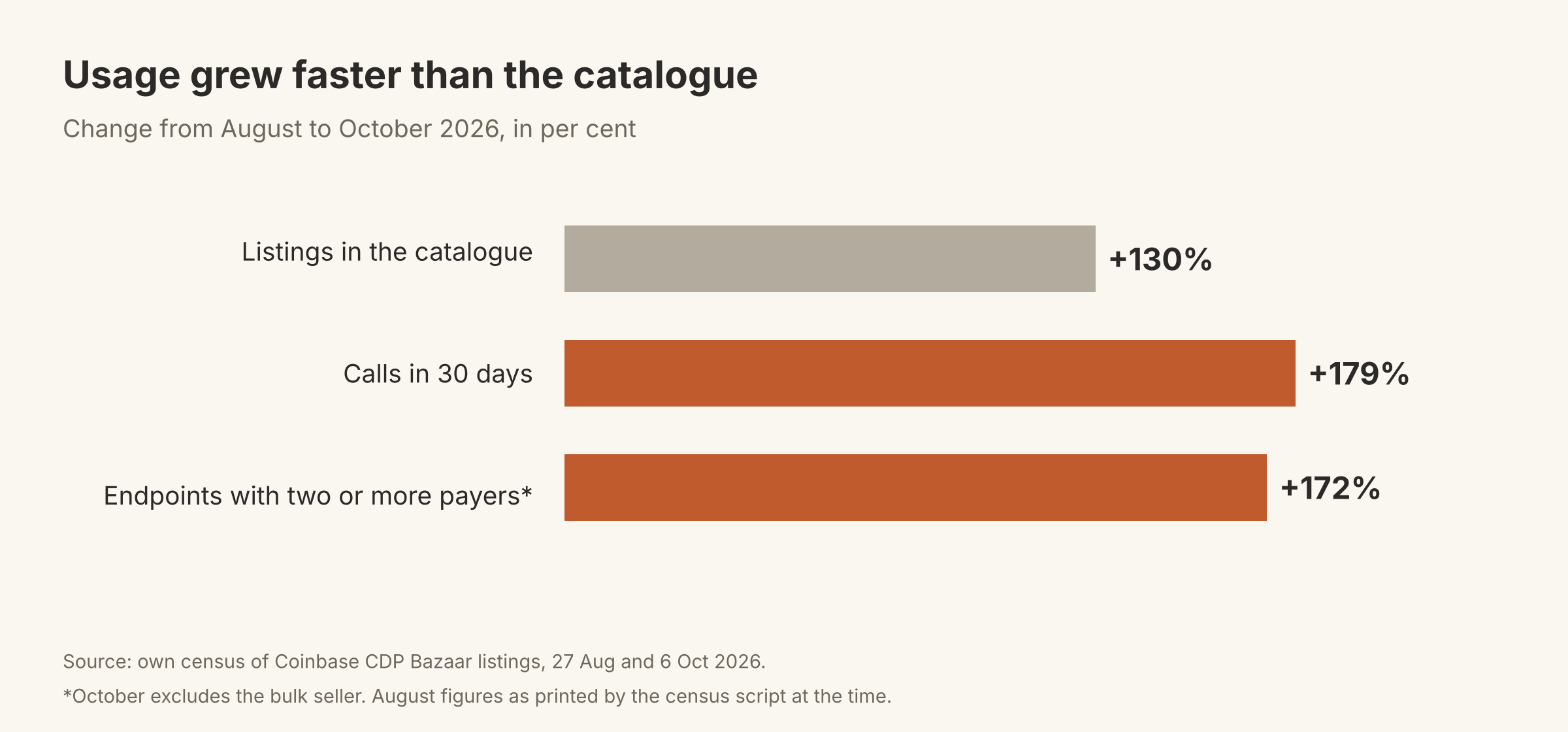
The catalogue more than doubled, with an asterisk
The catalogue grew 130 per cent in six weeks. But almost 40 per cent of October’s listings come from one seller, which I started calling the bulk seller: 13,776 listings on one website, all paying out to the same wallet. None of them was called more than four times. That seller makes the market look bigger and busier than it is. So I left it out to not obstruct the statistics.
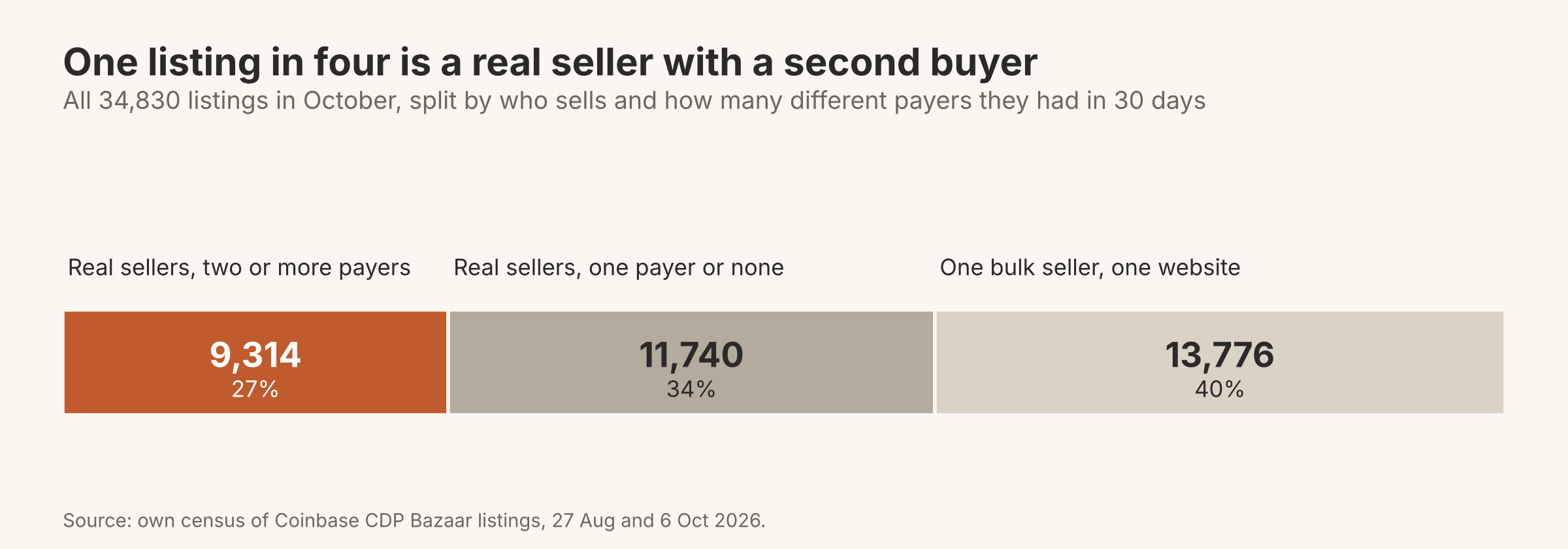
Usage still grew
Even without the bulk seller, the usage grew faster than the catalogue itself. More calls, and more endpoints with a second buyer. Six weeks earlier the market was more similar to a ghost town than a market.
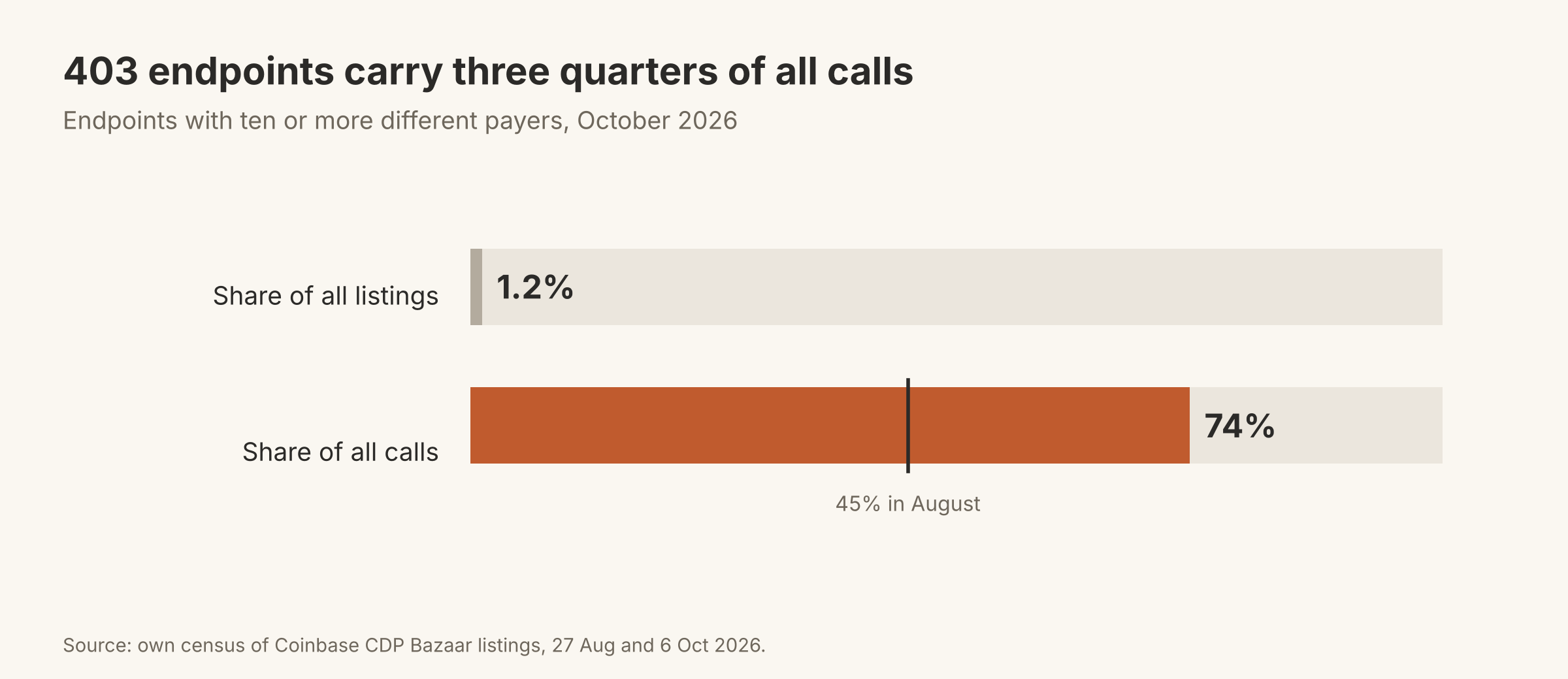
But it goes to the same few hundred
The growth is there, but it goes to the same few hundred endpoints. 403 endpoints with ten or more different payers now carry three quarters of all calls. Everyone else is still waiting for a second customer.
The median did not move
The typical endpoint had one paying customer in August. In October it still has one. So the median didn’t move despite the growth.
The money
There is no revenue, at least not now. The whole catalogue settled at most $57,364 in 30 days. At most, because an x402 listing shows a maximum price, not a receipt. And $27,000 of that is one gift-card listing, with a maximum of $1,000 per invoice, called 27 times. Leave that one aside, and everything else settled about $30,000 in a month. Around a thousand dollars a day, across almost 35,000 endpoints.
This answered my pricing question from the start. A seller who earns close to nothing will not pay €149 a month to find out why.
And this also brings up some follow-up questions: Are these sellers just playing around with that technology, are they all super early, or what is the actual problem? Why are they not having more engagement on their agentic payment endpoints? Because the answer to this question determines whether this is a growth market that I’m just very early on, or if this is not a market at all.
What the bulk seller’s traffic looks like
On that one website, almost every listing had either one payer and one call, or two payers and two calls. Nobody ever came back for a second purchase. And all of it happened within the same ten days.
Real endpoints don’t look like that. Where there is real traffic, the same payers come back again and again, and the busiest endpoints have thousands of them.
To me, that looks like someone testing their own listings after putting them up, not like customers. I can’t prove it though. The catalogue tells you how many payers an endpoint had, not who they were.
And the real sellers are not far off either: 42 percent of their listings have one payer and exactly one call. Lot’s of shops with a single visitor, it looks like.
Who is this market actually for?
I am not the only one who has counted. The headline numbers for x402 are big: more than 200 million transactions by mid-2026, and a foundation under the Linux Foundation with Visa, Mastercard, Stripe, Google and Coinbase among its members. The real numbers underneath are small. Artemis found that more than 95 per cent of the activity is machines testing the infrastructure, not buyers and sellers (Yahoo Finance). Real commercial volume was about $28,000 a day in March, and around half of the transactions were wash trading or self-dealing (PANews via Bitget). A Visa and Artemis analysis puts the real total at about $19 million once that is removed (Startup Fortune).
My census looks at a smaller slice, the services listed in one catalogue, and it points the same way. The pipes are being built at full speed. The traffic through them is still mostly testing.
Standard advice would be: if you sell to agents, make sure an agent can tell what your endpoint is worth before it pays.
But I’m not buying it. I’m not even sure these sellers are really trying to sell to agents. I think they are trying to sell to the people who send their agents to make a purchase or a payment.
So this whole exercise leaves me with two realizations: One, it was a very insightful research exercise into the agentic payments market. Two, and more importantly, does this market serve a bigger purpose, or is it a playground to try out this new way of sending your AI agent to buy a product or a service? And is it really taking off?
How Qyvern works, and what I would like to know
Qyvern sends a swarm of six AI agents at an endpoint, each focused on its own task. Some act like real buyers and try to work out whether the endpoint is worth paying for.
One wants a clear price. One wants a sample it could build against. A sceptic wants claims it can check before money moves. A volume buyer wants signs the endpoint will hold up under repeated calls. A first-timer wants to understand it without any background. And a compliance buyer wants to know who is behind it and what happens when something fails. Each one says whether it would pay, and if not, what stopped it.
At the end you get a score out of 100 and a report: why the agents declined to pay, and what to change. The score comes mostly from the collected facts. The buyer agents’ refusals can pull it down a little, never up. I’ll go deeper into how it’s built in a later piece, if readers want it.
Qyvern is publicly available and free to try at qyvern.ai. I’m happy for every user who tries it on their own endpoint. But what I would really appreciate is the background. Why are you testing your endpoint in the first place? Which industry are you in? What are you trying to sell, and who are you trying to sell to? And why did you choose an agentic payment endpoint to do it?
All of that tells me whether the agents’ reasons for refusing to pay make sense at all. If an endpoint is a playground or an exercise, they don’t matter much. But if you are selling real products, subscriptions or services through an agentic payment endpoint, I’m sure you want to know whether it does the job. If that’s you, reply to this post or write to me. I read everything.
Sources
The x402 Foundation Activated a 27-Year-Old Internet Code. 200 Million Transactions Later, the Real Volume Is Still Tiny, Yahoo Finance, 4 August 2026
Analysis: x402 protocol’s average daily trading volume is only $28,000, PANews via Bitget, 11 March 2026
AI agents have moved over 200 million payments on x402, but half may be fake, Startup Fortune, 14 October 2026