


This week a post came through my LinkedIn feed: a screenshot of a list by Oliver Molander.
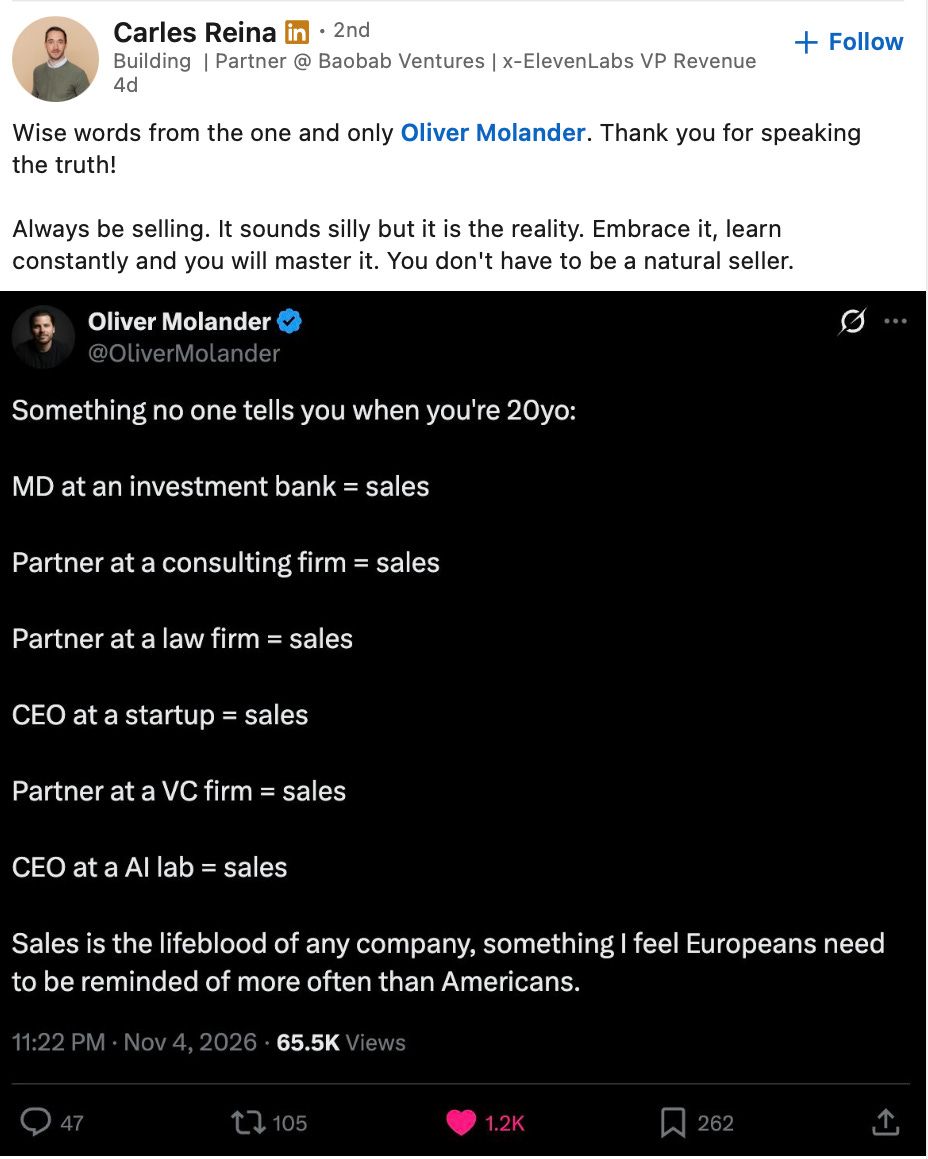
Today I’m 41, and I fully agree. I just took a very long way round to get here, and most of it was about one word.
My first experience with sales
My first experience with sales is why I was always so reluctant to call it that. And why I still don’t like it.
Today I build partnerships for a heat pump technology company. And I’ve always had something of an entrepreneurial streak: a side project here, a tool there, sometimes one that becomes a business. It’s a kind of balance for me, much like mountain biking or weightlifting. To generate business you need to do sales, in a way. But I always described it as strategic partnerships and storytelling, finding solutions to problems, understanding the customer’s need. Describing my way around it, instead of saying outright what it is.
That comes from my first experience with typical sales: a network marketing business. You go from door to door, you go around your circle of friends, acquaintances and relatives, and you try to sell them some solution that nobody really needs. The people I was working with at the time were taking advantage of people day and night. That whole lack of character. Just trying to out-talk people, and pressure-talk them into making bad decisions.
I bought into it myself, and it cost me dearly, both financially and in personal relationships. I wasn’t the only one. Hundreds of thousands of people did. Years later, it turned out to be a Ponzi scheme, with court verdicts in several countries.
Some of the people who got me into it were friends from childhood. Growing up, I always thought very highly of them, that they would live by the same ethical standards as I did. An untested assumption, but that’s what you get for trusting blindly.
That chapter was a punch in the stomach. The losses, and the realization that I had been betrayed on a colossal scale, likely from the start, are what started my drive to learn as much as I could about management, investing and financial markets.
What the word means in my head
At the time, that was my association with sales, and it’s why I hated the term so much. I still don’t care for it.
Typical sales, in my head, is someone sitting at their desk in their cubicle, picking up the phone and calling people to sell them some stupid solution. No interest in what the customer needs. No long-term partnership, no benefit for both parties, no fairness. In German I would say Leute ausnutzen. Exploiting people, or getting the better of them, would be an accurate translation.
Worst case, you pick up the phone, you read off a script, the person says no, and you call the next one. A horrible use of people’s time. I know it can produce results. I’m not arguing that.
Business development I can get along with better. You develop business. That is totally acceptable and fair, and I think it’s what’s needed everywhere.
The interview in the hotel room
When I saw the post, I was immediately reminded of an interview I did three or four years ago, with an accelerator in California. The venture was about trading electric vehicle battery capacity on the grid and earning grid rewards.
I was travelling for my day job and did the interview late at night in my hotel room. Munich, I think, near the train station. The interview was for a CEO position, and the interviewer asked me what my position on sales was.
I described it, maybe a bit less clearly than I would today, as the advantage I bring: storytelling, finding a good solution for a customer, solving common problems. All of which is what a good sales manager does. But I said: well, I’m not the typical salesperson.
I was thinking of some of the key account managers I’d worked with in the energy industry. They are relentless. They don’t take no for an answer, and they will tell you anything. And I was thinking of the people who got me into network marketing.
Then he asked whether a CEO has to do sales. Yes, of course. When I started my second company, I was alone for real. I could call myself CEO, but I also had no business. My main job was to create some. What else? I just didn’t call it “doing sales every day”, because sales sounded so stupid and so narrow-minded to me.
All of that was playing a role, and I couldn’t convey it well in that interview. I was against the term, not against the concept. That didn’t come across favourably. And of course I wasn’t selected in the end.
What changed
When I read the post this week, I thought: yep, now I get it. And I can’t be that picky about the wording anymore, because frankly it stops mattering. I’m met at eye level by my current company, and by its two original founders.
They’re both very capable and tackle problems as they come. They’re practical, they try to find the best solution and make the deal. But they also understand that you have to speak in a way that your audience understands, in easy terms, whoever you’re speaking to at the time.
In the past, a title or job description carried all the weight and decided how others perceived me. Now this company sees me for who I am, not just the role I’m currently working in. Once you’re no longer reduced to a task or a job title, and are seen as a person with all your facets, the title stops mattering. And so does the wording.
That’s something I only realized in this current job, and it took me a long time. Way too long. Arnold would say: “See the positive things, you grew professionally and personally. That is progress.”
For me personally, it still feels like it took way too long. Maybe that’s hindsight bias.
Do Europeans need reminding?
Do Europeans need to be reminded of that more than Americans do? I don’t know if they do. Especially in German-speaking countries, sales, or Vertrieb, comes with a negative association. Historically, the Vertriebler were the people going door to door. They did the dirty work, the footwork, and they would tell you pretty much anything to sell their product.
Vertrieb also comes from the German word vertreiben, from treiben: to drive, to push. I don’t come to you to ask for your service or product; you actively go out and try to push it into the market.
I can’t really say if that’s a European thing, rather than a German-speaking one. But in Sweden, and as far as I can tell in the Nordics, the hard American sell is a no-go. The other person will quietly and politely move away from the conversation. Instead, you describe the problem, find a solution, and weigh it from different angles until everybody included in the decision can agree. Then arriving at the purchase is a natural thing.
So I agree with the post in part, but it’s too simply put. The Americans have a much cruder approach, and granted, it works in a lot of industries in Europe too. But the main question is: what are you trying to sell? If you sell high-value, complex products or solutions, pressure is kryptonite. If you use it, you lose. Relationship, trust, and understanding the problem your customer wants to solve are key. Then the rest happens on its own. That sounds a bit naive, but it’s effectively the way it works.
In Europe, the founder’s skill, the CEO’s skill, the salesperson’s skill, or in my case the partner manager’s skill, is speaking the audience’s language: understanding their situation, their conditions, their dependencies, and taking the time. Sometimes it may feel like a deal has gone cold. But every company consists of people, there is always too much to do, and sometimes things take longer. Staying in the race is sometimes enough to get you over the finishing line.
So, sales. I still don’t like the word. But I was always against the word, not the work.